





US hotels had one of their strongest summers on record. What makes the numbers interesting, though, is how that growth happened.
Between Memorial Day and Labor Day, occupancy averaged 68.3%, ranking just 18th among the past 27 summers. At the same time, average daily rate (ADR) rose 4.6% year over year and revenue per available room (RevPAR) increased 5.8%.
STR, whose figures were published by CoStar, concluded that stronger rates accounted for most of the RevPAR growth.
For independent properties, that’s useful context. A full booking calendar can tell you plenty, but it’s only one part of the picture when you’re deciding how well a period actually performed.
Rates carried more of the growth
Demand was strong during summer 2026.
This year’s period between Memorial Day and Labor Day lasted an unusually long 108 days. Once STR adjusted for that, US room demand ranked third highest behind only 2018 and 2019.
Occupancy, however, remained well below the 72.8% peak recorded in summer 2018. The combination is what makes this summer stand out: plenty of people were traveling, but RevPAR growth came more from what guests paid for rooms than from exceptionally high occupancy.
There are two caveats. The ADR and RevPAR records are nominal, meaning they aren’t adjusted for inflation. And these figures describe the US hotel industry as a whole, so they include markets and property types that may behave very differently from your own.
That makes them interesting context rather than a rate recommendation.
ADR and RevPAR: two numbers, two different questions
ADR and RevPAR answer slightly different questions.
ADR asks: What did the guests who stayed pay for their room, on average?
It is calculated by dividing room revenue by the number of rooms sold.
RevPAR asks: How much room revenue did each available room generate?
It divides room revenue across every room available, including the ones that stayed empty.
The relationship between the two is simple:
ADR × occupancy = RevPAR
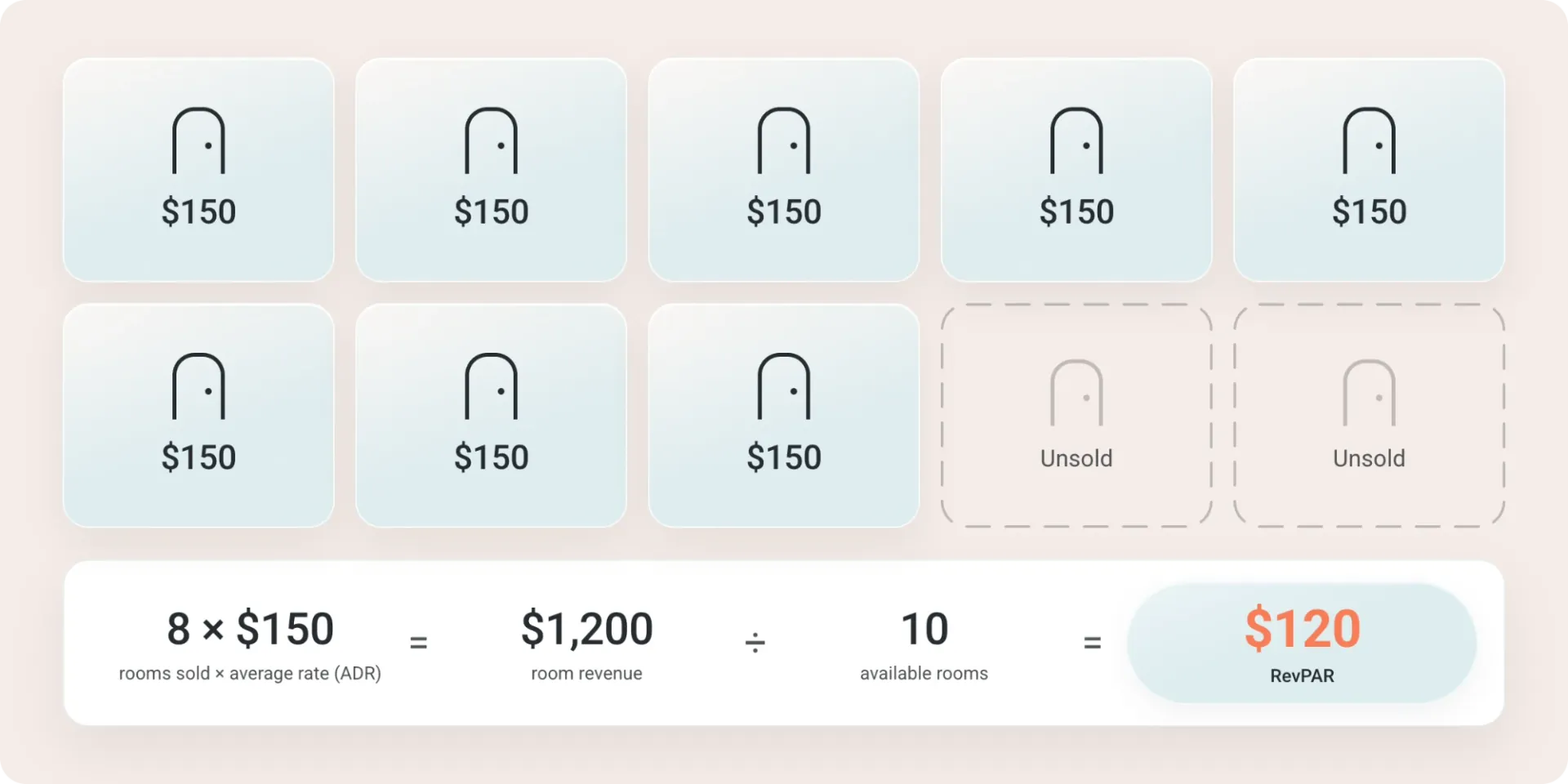
Take a ten-room property. If eight rooms sell at an average of $150, occupancy is 80% and total room revenue is $1,200.
The ADR is $150. Spread that $1,200 across all ten available rooms and RevPAR is $120.
Or run it through the formula: $150 × 80% = $120.
RevPAR can improve because you sell more rooms, achieve a stronger average rate or both. It is still a top-line room-revenue measure, so it doesn’t account for costs such as cleaning, laundry, commissions or staffing.
Full isn’t the same as performing well
Imagine two similar Saturdays at that same ten-room property.
On the first, eight rooms sell at an average of $150, bringing in $1,200. On the second, nine rooms sell at an average of $130, bringing in $1,170.
In that example, the fuller night earns less room revenue.
Real pricing decisions are rarely that tidy, of course. A lower rate may be exactly what a genuinely quiet date needs, while another date may already have enough demand to sell at the existing price.
That’s where booking pace becomes useful. If a Saturday is already filling earlier than comparable Saturdays did last year, holding the rate and watching might make more sense than cutting it because a couple of rooms remain.
The reverse can also be true. If Tuesdays repeatedly stay open until the last minute, a different price or offer may help.
Occupancy deserves company. Looking at it alongside the rate guests actually paid gives you much more context.
World Cup markets are a reminder to stay local
The 2026 FIFA World Cup provides a good example of just how different local demand can look.
During the first full week of the tournament, RevPAR among midscale and economy hotels in host markets rose 11.1%. Occupancy declined across every hotel segment in those markets.
Non-host markets also performed well that week, but under different conditions. Their RevPAR increased 6.8%, supported by 5.2% ADR growth and a 2% increase in room demand.
Both sets of figures contributed to the wider US story, but they came from very different circumstances.
A property near a major event may have pricing opportunities that simply don’t exist for a small inn, motel or B&B elsewhere. The same applies on a smaller scale to festivals, graduations, weddings and other events closer to home.
National numbers can give you something to think about. Your own booking patterns and local calendar are usually much more useful for setting a rate.
Before you lower a rate, look at how the date is selling
You may already have most of the information you need sitting in your booking history.
Before changing a price, it can help to check a few things:
- Compare booking pace with a useful baseline. How many rooms were already booked for a similar date last year, or during another comparable period?
- Look at rate and occupancy together. A busy date at a heavily discounted rate tells a different story from a busy date that held its price.
- Notice recurring patterns. Which dates fill early? Which tend to stay open? Which usually sell only after the price changes?
- Check what’s happening locally. Events, holidays and seasonal travel patterns can affect your demand far more than a national average.
- Make a deliberate change, then review it. Adjusting one period or set of dates at a time makes it easier to see whether booking pace and room revenue moved the way you hoped.
That might mean leaving a Saturday alone because it is already booking faster than usual, while trying a different price on the quieter Tuesdays around it.
Once you’ve made that decision, Sirvoy gives you practical ways to put it in place. You can review and change rates, use temporary prices for particular dates or periods and keep rates, restrictions, availability and bookings updated across connected channels.
Your direct booking engine also lets you control the prices guests see when they book through your own website.
You still decide what makes sense for the property and the date. Sirvoy is where you apply that decision and keep it current.
What to take from summer 2026
This summer’s figures are a reminder to look beyond occupancy when you review your own performance.
A busy property can still be underpricing its rooms. A night with a few vacancies might still be performing well. And an unsold room doesn’t automatically mean the rate was wrong.
If you want somewhere simple to start, choose one weekend from last summer that felt quieter than you wanted. Look at when the rooms actually booked, what guests paid and whether you changed the rate along the way.
You might find that the lower price helped. You might find that the rooms would probably have sold anyway. Or you might simply spot a pattern worth watching the next time that weekend comes around.
Enjoyed this article?
Follow Sirvoy for practical tips, product news and fresh ideas to help your property get more bookings.